The West holds France and the Low Countries. The East holds Poland, Bohemia and Saxony. Between them lies Germany, from the Rhine to the Oder, with the Alps to the south. It's all neutral at the start, and it's where every game is decided.
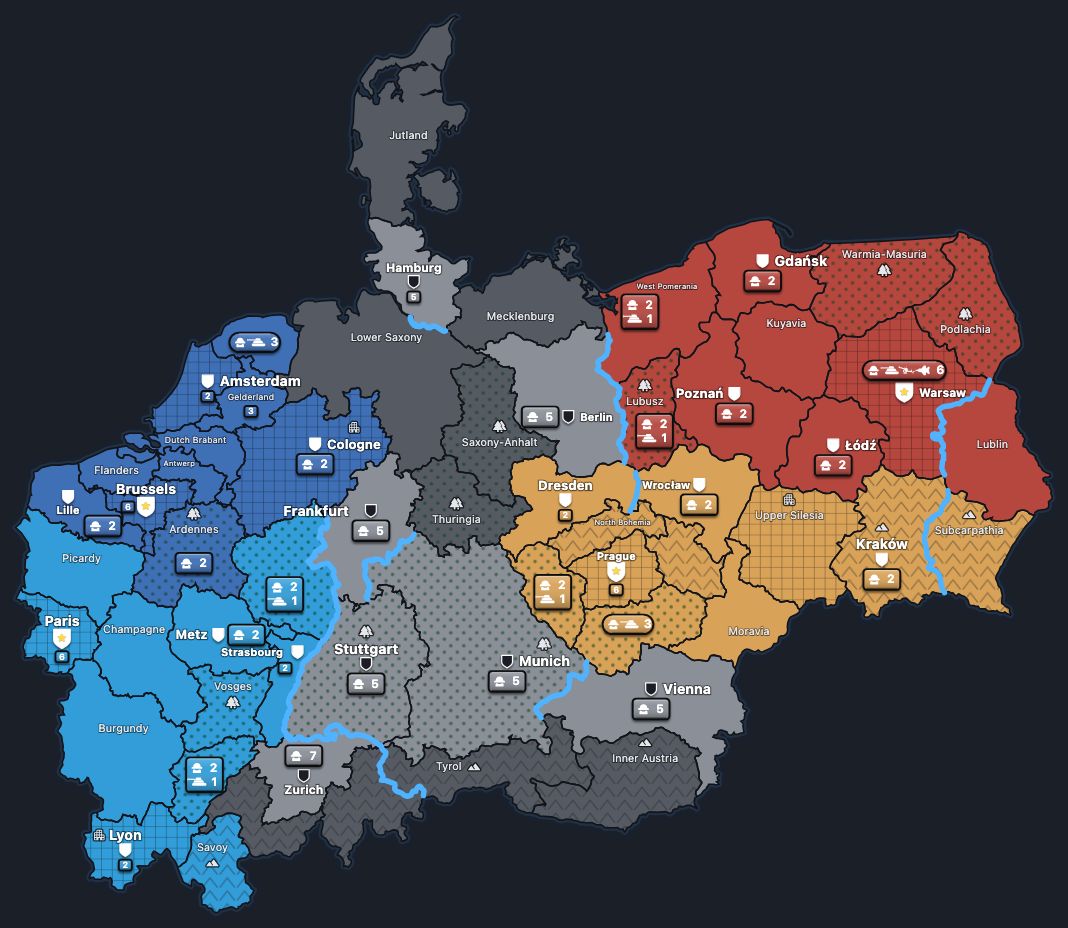
At a glance#
- 58 provinces: 28 plains, 13 forest, 9 mountain and 8 urban.
- 23 cities, 4 of them capitals: Paris, Brussels, Warsaw and Prague.
- Modes: 1v1 and 2v2.
- Rivers: the Rhine, Elbe, Main, Danube, Oder and Vistula run along 13 province borders.
The sides#
In a 2v2, each team splits its half of the map in two. One West player holds the Low Countries and the Ruhr, the other holds France. One East player holds northern Poland, the other Saxony, Bohemia and southern Poland.
| Side | Home cities (capitals in bold) | Starting units |
|---|---|---|
| West: the Low Countries and the Ruhr | Brussels, Amsterdam, Lille, Cologne | 15 infantry, 3 armor, 1 artillery, 1 plane |
| West: France | Strasbourg, Paris, Metz, Lyon | 13 infantry, 3 armor, 1 artillery, 1 plane |
| East: northern and central Poland | Poznań, Łódź, Warsaw, Gdańsk | 13 infantry, 3 armor, 1 artillery, 1 plane |
| East: Saxony, Bohemia and southern Poland | Prague, Kraków, Wrocław, Dresden | 13 infantry, 3 armor, 1 artillery, 1 plane |
In a 1v1 each side holds its whole half.
| Side | Home cities (capitals in bold) | Starting units |
|---|---|---|
| West: France and the Low Countries | Strasbourg, Brussels, Amsterdam, Paris, Metz, Lyon, Lille, Cologne | 28 infantry, 6 armor, 2 artillery, 2 planes |
| East: Poland and Bohemia | Prague, Poznań, Kraków, Łódź, Wrocław, Warsaw, Gdańsk, Dresden | 26 infantry, 6 armor, 2 artillery, 2 planes |
The neutral band#
Seven cities sit in the band between the sides: Hamburg (5 infantry), Berlin (5 infantry), Frankfurt (5 infantry), Stuttgart (5 infantry), Munich (5 infantry), Vienna (5 infantry), Zurich (7 infantry).
Most fall to the side that's closer. Frankfurt, Stuttgart and Zurich are within the West's reach, while Berlin and Vienna sit next to the East. Zurich has the biggest garrison because only the West can reach it early.
The real contests are Munich and Hamburg. Munich sits in the Bavarian forest, closer to the East but reachable from the Rhine. Hamburg is at the top of the map, on the far side of the Elbe from the West. In our bot test games, Munich is close to a coin toss, and the East usually ends up with Hamburg.
Terrain and rivers#
- The Rhine is the West's moat. It runs along the borders of Alsace, the Palatinate and the Swiss Plateau, so an East attack across it is weaker. The same river slows a West push into Baden-Württemberg and Hesse.
- The north is open plains. The Netherlands and the Ruhr look across flat country at Lower Saxony and Hesse. On the far side, the Oder runs between Poland and Brandenburg. Armor moves fast here, and nothing slows an attack.
- The south is walled. The Alps (both Swiss provinces, Tyrol and Inner Austria) are mountain, and the Ore Mountains and the Bohemian Forest shield Bohemia. Forests cover Bavaria, Baden-Württemberg, Thuringia and the Ardennes.
- The big cities are urban: Holland, Brabant, the Ruhr, Île-de-France, Lyonnais, Masovia, Central Bohemia and Upper Silesia. Urban ground defends at +50%, and armor attacks into it at ×0.5, so send infantry and guns.
How it plays#
The band falls in the first few turns. After that, the game becomes two fronts at once: the open north around Hamburg and Berlin, and the forested south around Munich and Stuttgart. Games against even opponents run about forty turns.
A lead at turn ten is hard to overturn here. Each front city is worth several units a turn, so losing one early costs more than it seems.
Tips#
- Pick your band cities. You can't take them all on turn two. Take the ones next to you, and watch the contested pair.
- Use the Rhine. The West can sit behind it in Alsace and the Palatinate and send its armor north into the open plains.
- The East has the shorter road to Berlin and Vienna, so take them fast and turn on Munich before the West arrives.
- Don't push into the Alps. Armor attacking into mountains fights at ×0.5. Go around through the Swiss Plateau or the Danube valley.
About the map#
Provinces are built from European regions (Natural Earth, public domain) and merged where they were too small to play. Some names are broad: the Ardennes covers the Belgian Ardennes, Luxembourg and a slice of France. Hesse is played as plains, though it's hilly and wooded, and the sides are game blocs, not real countries.