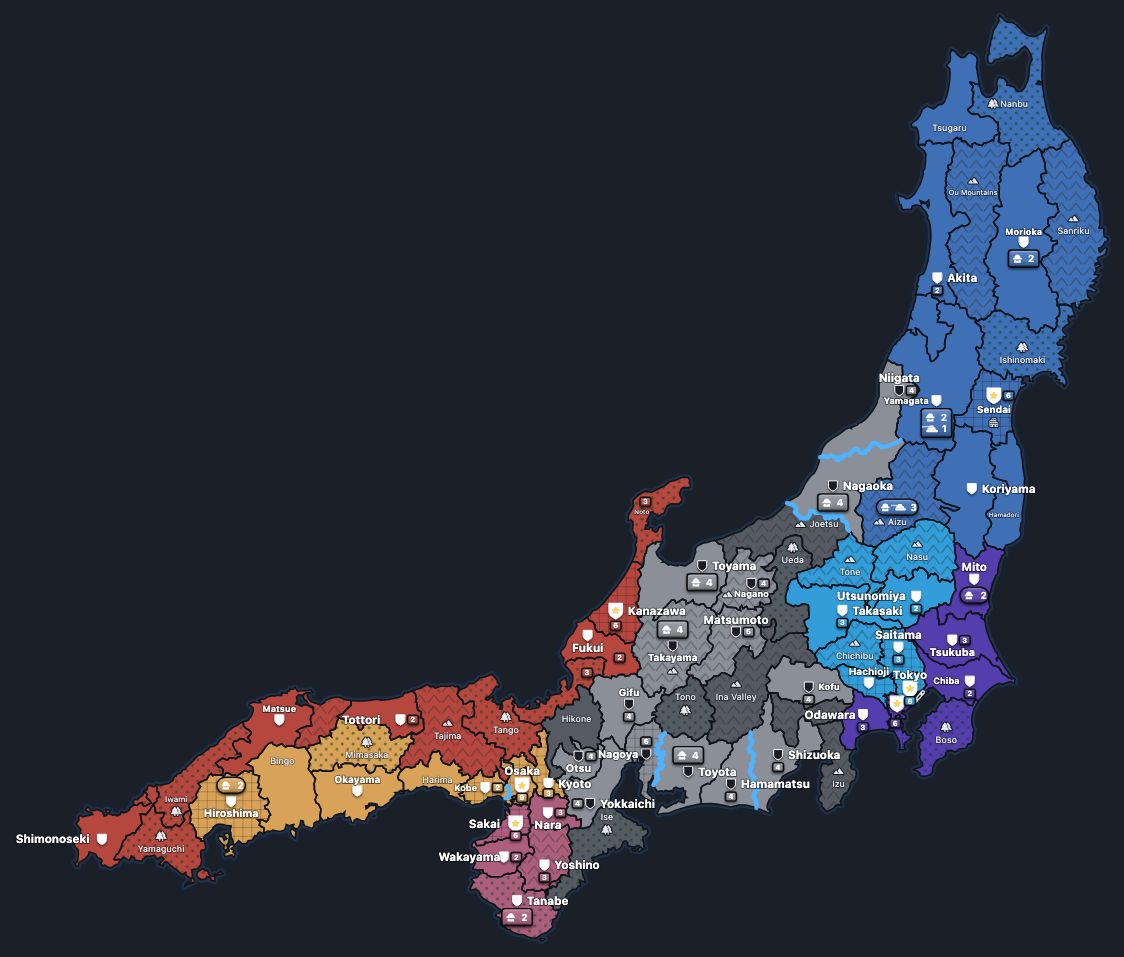
Japan's main island, three against three. The East holds Tohoku, Tokyo and the Kanto plain. The West holds Osaka, Kyoto and everything from the Sea of Japan to Shimonoseki. Between them, the Japanese Alps and the Tokaido corridor are full of neutral cities, with Nagoya, the biggest of them, in the middle.
At a glance#
- 74 provinces: 33 plains, 13 forest, 16 mountain and 12 urban.
- 44 cities, 6 of them capitals: Sendai, Tokyo, Yokohama, Kanazawa, Osaka and Sakai. It's the map with the most cities, so there's always something to take.
- Modes: 3v3.
- Rivers: few. The Shinano and a handful of others run along 5 province borders. Mountains do the walling here.
The sides#
Each team plays three lanes: the Sea of Japan coast in the north, the mountain spine in the middle, and the Pacific coast in the south.
| Side | Home cities (capitals in bold) | Starting units |
|---|---|---|
| East: Tohoku | Akita, Morioka, Koriyama, Sendai, Yamagata | 11 infantry, 3 armor, 1 artillery, 1 plane |
| East: Tokyo and inland Kanto | Saitama, Takasaki, Hachioji, Tokyo, Utsunomiya | 9 infantry, 3 armor, 1 artillery, 1 plane |
| East: Yokohama, Chiba and Ibaraki | Chiba, Mito, Odawara, Tsukuba, Yokohama | 11 infantry, 3 armor, 1 artillery, 1 plane |
| West: the Sea of Japan coast | Fukui, Kanazawa, Matsue, Shimonoseki, Tottori | 11 infantry, 3 armor, 1 artillery, 1 plane |
| West: Osaka, Kobe and the Inland Sea | Hiroshima, Kobe, Kyoto, Okayama, Osaka | 11 infantry, 3 armor, 1 artillery, 1 plane |
| West: Sakai and the Kii peninsula | Tanabe, Nara, Sakai, Wakayama, Yoshino | 11 infantry, 3 armor, 1 artillery, 1 plane |
Every player starts with a capital and four cities, so no seat starts poor.
The neutral middle#
Nagoya (5 infantry, 1 artillery), Niigata (4 infantry), Nagaoka (4 infantry), Toyama (4 infantry), Nagano (4 infantry), Matsumoto (5 infantry), Takayama (4 infantry), Gifu (4 infantry), Shizuoka (4 infantry), Hamamatsu (4 infantry), Kofu (4 infantry), Otsu (4 infantry), Toyota (4 infantry), Yokkaichi (4 infantry).
Most of them fall in the first few turns to whichever side is closer. The East takes Niigata, Nagaoka, Kofu, Shizuoka and Hamamatsu. The West takes Toyama, Gifu, Takayama, Otsu and Yokkaichi.
- Nagoya is the prize: a major city with a bigger garrison, including artillery. The West usually reaches it first.
- Matsumoto, Nagano and Toyota are the real contests, deep in the mountains and on the road between Nagoya and the Kanto.
Terrain#
- The Japanese Alps are a wall. Most of the middle of the map is mountain: Joetsu, Nagano, Matsumoto, Hida, the Ina Valley and Mt. Fuji. A stack that enters one stops for the turn, and armor attacks into them at ×0.5.
- The Tokaido has a mountain gate. From Shizuoka west through Hamamatsu and Toyota to Nagoya, the Pacific coast is open plains where armor counts. But every way into Shizuoka from the east crosses a mountain province: Mt. Fuji, Izu or the Ina Valley. Whoever holds that gate decides how fast the East can come down the coast.
- The big cities are urban: Tokyo, Yokohama, Saitama, Osaka, Kyoto, Kobe, Nagoya and more. Urban ground defends at +50%.
- Tokyo Bay has a link: Yokohama and Chiba border each other across the bay, like the Aqua-Line.
How it plays#
The middle is crowded with cities, so the first ten turns are a scramble, and both teams end up larger than they started. After that, the fight settles on three fronts at once. Games run long, often fifty turns or more.
Tips#
- Each lane owns its front. With three lanes and walls of mountain between them, a lane rarely gets help in time. Plan your lane's own defence.
- Nagoya decides the south. Whoever holds it can push along the Tokaido either way. The East should reach it with artillery and planes, not just a stack of infantry.
- Don't feed the Alps. A slow march through the mountains costs turns. Go round by the coasts unless a mountain city is right in front of you.
About the map#
Provinces are prefectures cut along hand-drawn lines, and many are named after a region rather than a city (Nakadori, Tone, Kinan). Hokkaido, Shikoku, Kyushu and the smaller islands (Sado, Awaji, the Izu islands) aren't on the map. The sides are game blocs, not real factions.