How is a battle decided?#
Rule of thumb: each side adds up its strength. The stronger side usually wins, but not always.
A side's strength is the sum of its units: attack values for the side moving in, defense values for the side already there. Terrain, rivers, being dug in and supply change those numbers. Then support from artillery and air is added on top.
The chance of winning is A² ÷ (A² + B²), where A is your strength and B theirs. Being a little stronger helps a little. Being much stronger helps a lot:
| Your strength : theirs | You win |
|---|---|
| 1 : 1 | 50% |
| 1.25 : 1 | 61% |
| 1.5 : 1 | 69% |
| 2 : 1 | 80% |
| 3 : 1 | 90% |
What do the numbers on the attack pill mean?#
Rule of thumb: the crossed-out number is the plain fight. Each chip is one thing that changed it.
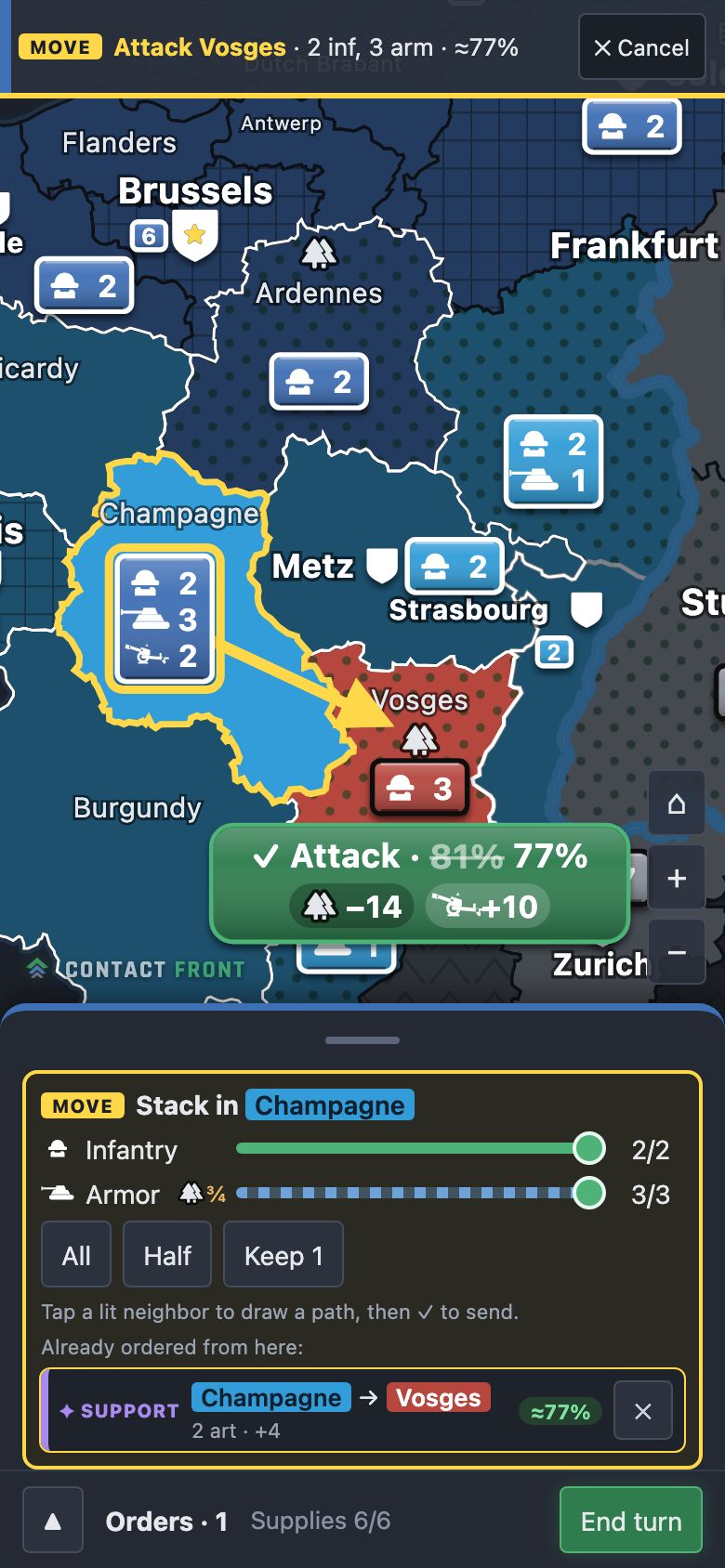
When nothing changes the odds, the pill is one line: ✓ Attack and your odds. When something does, it gets a second line. The crossed-out number is your moving troops' attack values against the defenders' defense values, with no terrain, river, dug-in, supply or support. The number beside it is your real odds.
Under them is a row of chips, one for each cause, with the points it added or took away. Dark chips are against you. Light chips help you. The chips add up to the difference between the two numbers. A chip can show terrain, a river crossing, a dug-in defender, supply (yours or theirs), artillery support or an air strike.
In the Move box, a unit with a terrain icon and a fraction after its name attacks at that fraction there: armor shows ½ in mountains, ½ in cities and ¾ in forest. Its slider is dashed.
Why did I lose a battle I was likely to win?#
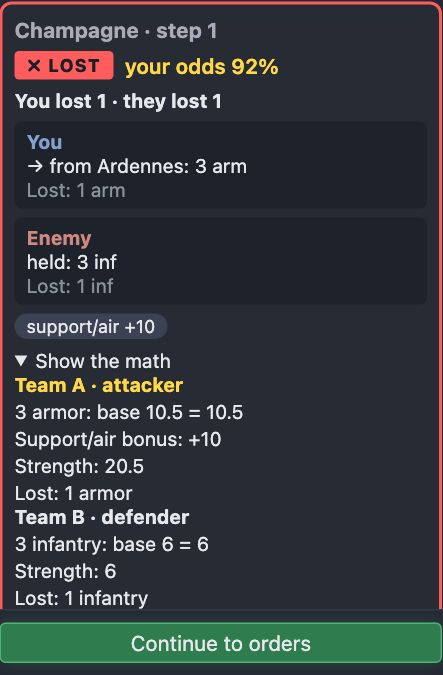
Rule of thumb: the odds are a chance, not a promise. At 90% you still lose one battle in ten.
Over a game you fight dozens of battles, so the unlikely ones do happen. Two other things make a battle go worse than its odds:
- The odds on your order only count the enemies you can see. A stack that moves in during the same step joins the fight.
- Defenders you didn't plan for. Enemy artillery next door and planes in range can add to their side.
The battle card in playback shows exactly what each side had. Open Show the math to see every modifier.
What does a battle cost?#
Rule of thumb: lopsided wins are cheap. Even fights are expensive for both sides.
Each side loses a share of its units equal to the other side's share of the total strength. The winner loses only 0.5× that.
| Fight | Winner loses | Loser loses |
|---|---|---|
| Even (1 : 1) | 25% | 50% |
| 2 : 1 | 17% | 67% |
Losses come off infantry, then artillery, then armor, then air. Infantry in an attacking stack soaks up the losses and keeps your armor alive.
One big attack or several small ones?#
Rule of thumb: hit one target with everything you have.
Win chance grows faster than strength. Against 4 infantry on plains, 2 armor (7 against 8) wins 43%. 4 armor (14 against 8) wins 75%, and the bigger attack loses a smaller share of its units.
Stacks that enter the same province in the same step fight as one side, your teammates' stacks included. Two stacks plus artillery and air on one target beat three separate attacks.
What if three sides march into one province?#
Rule of thumb: everyone who marches in rolls once, in proportion to strength. The winner then hits whoever was holding it.
This happens in a free-for-all. Strengths 10, 5 and 5 win 67%, 17% and 17%. See Free-for-all.
Who is attacking and who is defending?#
Rule of thumb: the defender is whoever was in the province at the start of the step.
Defenders get terrain and, in their own cities, the dug-in bonus. If nobody was there, both sides count as attackers. See Moving at the same time for border clashes and battles in empty provinces.