How does a turn play out?#
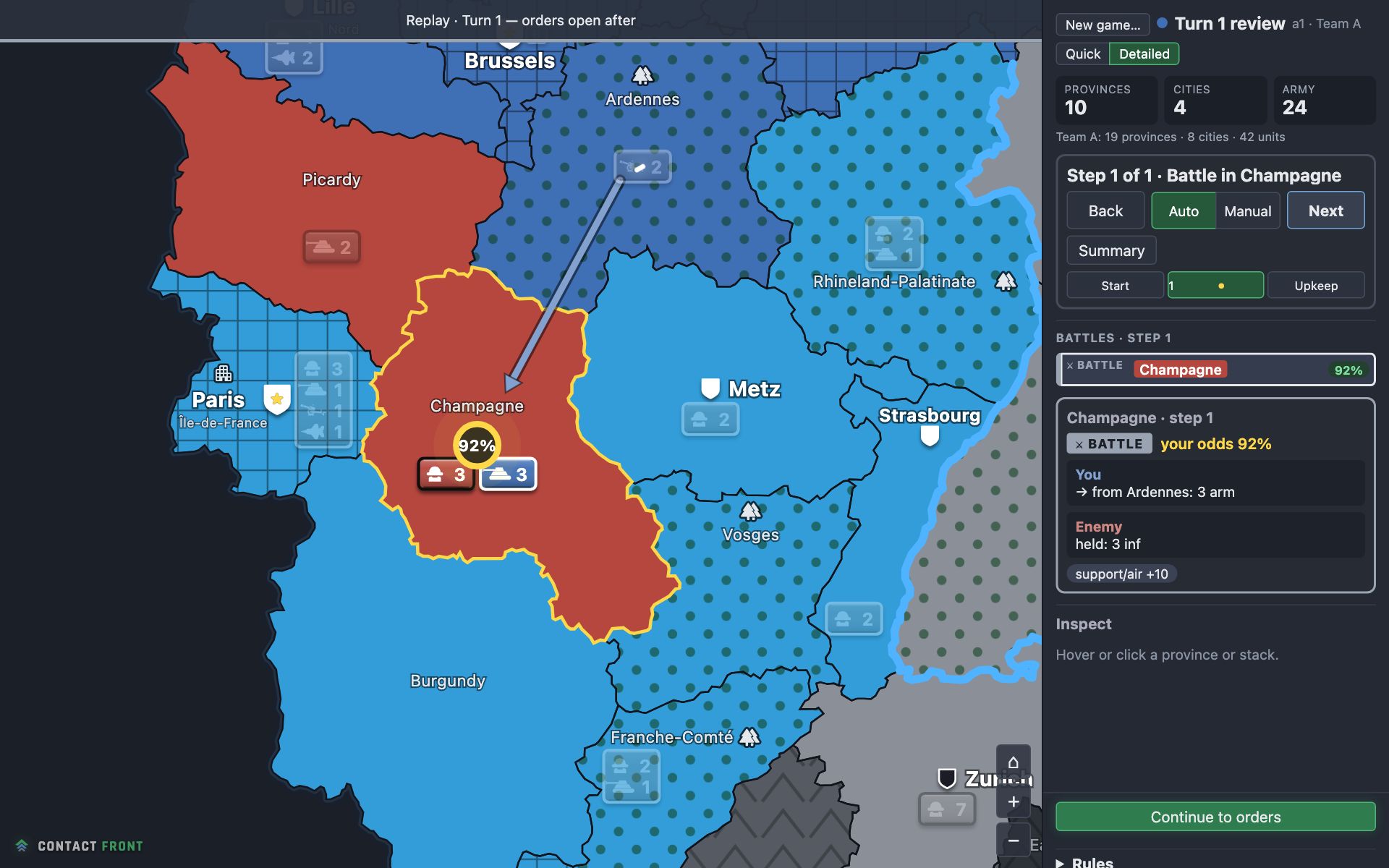
Rule of thumb: everyone orders at once, without seeing each other's orders. Then every move plays out together, one province per step.
When the turn ends, every stack on the board takes its first step at the same moment. Then they all take their second step, and so on. Infantry and artillery move 1 province a turn and armor moves 2, so most turns have one or two steps.
After each step, enemies standing in the same province fight. After the last step comes supply, then income, then new units.
Why can't I catch that enemy stack?#
Rule of thumb: you order a stack to where the enemy is now. By the time you arrive, it may have left.
If two stacks move at the same speed, the one being chased can always step away. With only two stacks on a board, a chase never ends.
So how do I catch someone?#
Rule of thumb: go where they will be, not where they are.
- Head them off. Move into the province they need: their city, their way home, the only gap in a river.
- Use armor's second step. Armor can drive through their province and on to where you think they're running. If you guess right, you catch them on step two.
- Threaten something they can't leave. A stack defending a city stops running. Attack the city, and the stack has to stand and fight.
- Corner them. Rivers and mountains end moves, and a stack that loses with nowhere safe to fall back to is destroyed.
- Or don't chase at all. Take the provinces behind them and cut their supply. See Supply & cutting off.
What happens when two armies move into each other?#
Rule of thumb: armies that swap places fight on the border. Terrain, rivers and being dug in don't count there.
This is a border clash. Both sides fight with their attack values, with no terrain, river or dug-in bonus, and artillery and air can't help either side. The loser stays where it started. The winner carries on into the loser's province and fights whatever is still there, so a small stack can't block a big army.
What if we both move into the same empty province?#
Rule of thumb: nobody is defending there, so both sides fight on attack. That's bad news for infantry.
Infantry attacks at 1 but defends at 2. In a province with no stack in it at the start of the step, it gets the weaker number. That's true even in a province you own. A side that crossed a river to get in is still weakened by it.
Why did my armor stop after one province?#
Rule of thumb: mountains, rivers and forest (for armor) end a move.
- Entering a mountain province ends any stack's move.
- Crossing a river ends any stack's move, armor too.
- Armor entering forest costs 2 moves, its whole turn.
- A stack moves at the speed of its slowest unit: armor traveling with infantry moves 1.
- A stack that fights a battle stops there, even if it wins.
My city fell without a fight. How?#
Rule of thumb: an empty city belongs to whoever walks in. Keep one ground unit in every city you care about.
You can't see the enemy's orders. If your last stack leaves a city on the same turn an enemy walks in, there's no one to fight, and the city changes hands.
Planes alone defend at 0, so they can't keep a city for long: keep ground units there. And planes in a city that falls are destroyed.
How do I read what the enemy will do next?#
Rule of thumb: ask where you would go in their place.
- Enemy stacks next to your stacks show exact counts. Further off, you see their unit types and a size range. Out of sight, you see nothing.
- Count their reach: infantry 1 province, armor 2. A big stack next to a thin city is an attack waiting to happen.
- The odds on your order only count the enemies you can see, so they can be too hopeful.
- Air scouting shows a province and its neighbors on your next turn. See Air.
Should I move or hold still?#
Rule of thumb: a stack that holds still defends with terrain and digging in. A stack that moves gets neither.
The defender in a province is whoever was there at the start of the step. Defenders use their defense value, plus the terrain bonus and, in their own cities, the dug-in bonus. Attackers use their attack value and lose some of it crossing a river.
When a battle is lost:
- A stack that moved in falls back to where it came from, if no enemy is there.
- A stack that was standing still falls back to a neighboring province your team owns with no enemy in it.
- If there's nowhere safe to go, the stack is destroyed.